
Table of Contents
- Intro
- The 8 Questions Your AI Visibility Dashboard Must Answer
- Q1: Which prompts actually matter?
- Q2: Where is the brand mentioned versus cited?
- Q3: How do competitors compare?
- Q4: Which sources do the engines pull from?
- Q5: How is visibility trending over time?
- Q6: How does visibility map to pipeline?
- Q7: Which engine deserves investment?
- Q8: What should be fixed first?
- Notes
- Conclusion
- Call to Action
- Sources
Intro
Gartner's survey of 645 B2B buyers found that 45% used generative AI during a recent purchase, while 69% still turned to sales reps to validate what those tools told them (Gartner). The AI answer now sits inside the buying committee. Most vendor dashboards still cannot show whether a brand appears in it.
AI visibility reporting is the systematic measurement of where and how a brand surfaces in AI-generated answers across ChatGPT, Perplexity, Gemini, Copilot, and Google AI Overviews, plus the sources those engines cite. This article does not reproduce a feature matrix. It supplies the eight questions a dashboard must answer with reproducible evidence — and the same criteria apply to Alef's AI visibility tracking, which monitors mentions, citations, rankings, and competitors across the prompts buyers actually type. Each metric named here is defined in the pillar, How to Measure AI Visibility. A dashboard that cannot answer all eight produces screenshots, not decisions.
The 8 Questions Your AI Visibility Dashboard Must Answer
Any AI visibility reporting platform can produce a chart. Very few can produce evidence a B2B buyer can act on. The distinction matters because AI answer engines do not expose the query-level data that traditional rank trackers were built around — there is no stable SERP position to scrape, no consistent result count, and no guarantee that the same prompt returns the same answer twice in a week. What remains measurable is narrower and more useful: whether the brand appears, whether it is linked, who else appears alongside it, and what those patterns do to pipeline.
The eight questions below are the evaluation criteria a marketing lead or GTM manager should apply before signing. Each one maps to a capability, and each capability either exists in a dashboard or does not.
Q1: Which prompts actually matter?
A dashboard must let the buyer define a prompt set drawn from real buyer questions, not vanity keywords. The unit of measurement in AI answer reporting is the prompt, and the prompt set is the foundation everything else is computed against. If the set is wrong, every downstream metric — share of voice, citation rate, trend — is wrong in a way that looks precise.
The practical test is whether the platform accepts structured, long-form buyer questions such as "best enterprise CRM for mid-market retail with Salesforce integration" or "how do B2B software teams evaluate AI visibility vendors," and whether it tracks them individually rather than rolling them into a single brand score. Prompt-level tracking reveals that a brand can dominate "AI visibility measurement" prompts while being entirely absent from "AI visibility reporting for B2B" prompts — a distinction that a blended score erases.
Alef's prompt intelligence and tracking capabilities run structured buyer questions through ChatGPT, Gemini, and Perplexity to measure brand visibility, mentions, and source citations at the prompt level. The pillar guide on how to measure AI visibility explains how prompt coverage maps to revenue rather than to mention volume, which is the reason prompt selection deserves this much scrutiny.
Three questions to ask a vendor here:
- Can the prompt set be edited without resetting historical trend data?
- Are prompts grouped by funnel stage — awareness, evaluation, comparison, procurement?
- Does the platform distinguish prompts where the brand is absent from prompts where it was never tracked?
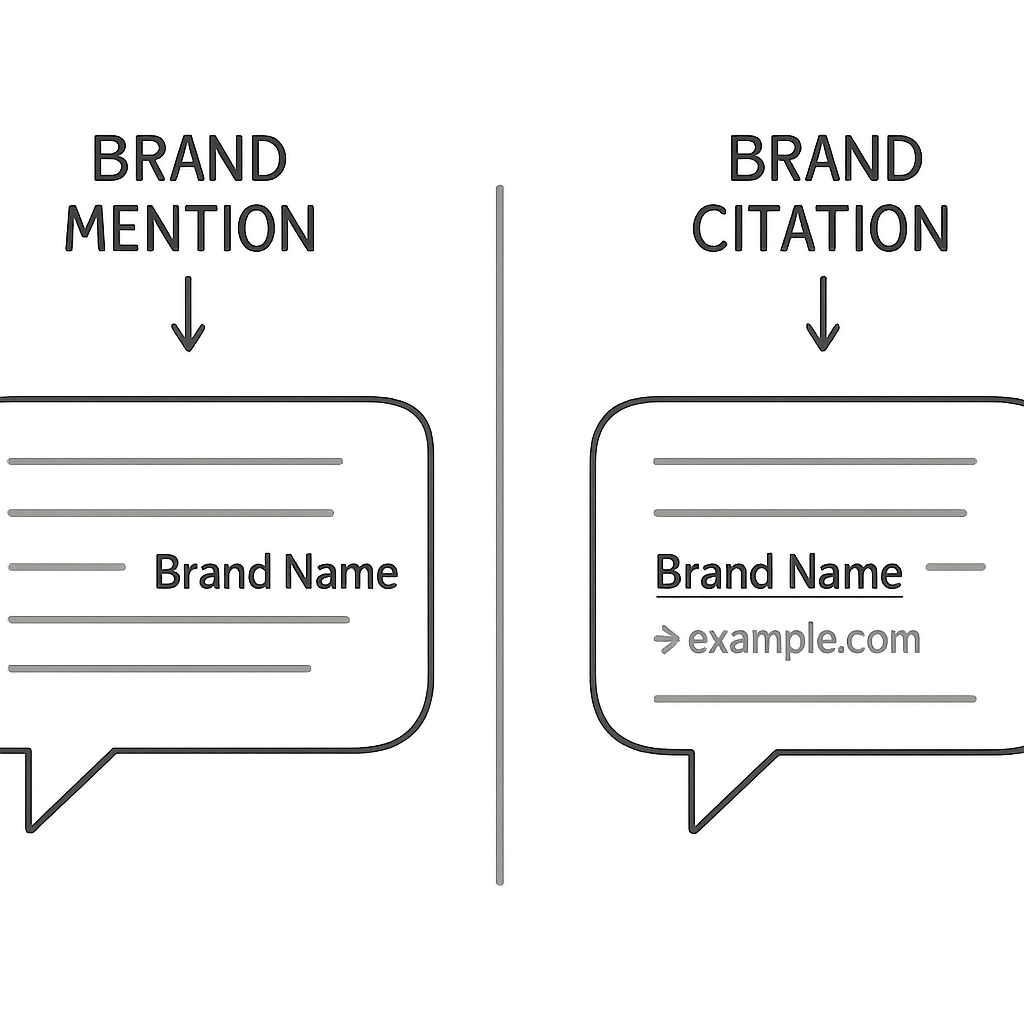
Q2: Where is the brand mentioned versus cited?
The dashboard must separate a mention from a citation, because they are not the same asset. A mention means the brand name appears in the answer text. A citation means the engine links to the brand's URL as a source. A mention without a citation is borrowed authority — the engine has absorbed the brand's reputation from third-party sources and repeated it without sending anyone to the brand's own property. A citation is owned: it is a durable, clickable reference that survives answer regeneration.
This distinction has direct commercial weight. Pew Research Center found that Google users are less likely to click on links when an AI summary appears in the results, which means an uncited mention produces almost no downstream traffic. Seer Interactive's September 2025 analysis of AI Overviews and organic click-through rate reaches a similar conclusion from a different dataset.
The pillar's treatment of why citation share predicts pipeline better than raw mention counts is the reference point here. A dashboard that reports only "mentions" is reporting the weaker of the two signals and calling it visibility.
Q3: How do competitors compare?
Share of voice must be computed across the same prompt set for a named competitor group. A single-brand visibility score has no interpretive value on its own — 34% visibility sounds strong until the same dashboard shows three competitors at 61%, 58%, and 47% on the identical prompts.
The dashboard should allow the buyer to define a competitor set (typically three to seven named companies), then report each one's mention rate and citation rate per prompt. That produces the comparison a GTM team actually needs: not "are we visible" but "on which prompts are we losing, and to whom."
Two structural requirements make this comparison trustworthy:
| Requirement | Why it matters | Failure mode if absent |
|---|---|---|
| Identical prompt set across all brands | Comparison must be apples-to-apples | Vendor reports brand on 200 prompts, competitors on 50 |
| Per-prompt competitor attribution | Shows which rival wins which question | Blended share of voice hides prompt-level losses |
| Time-aligned snapshots | All brands measured in the same window | Competitor data lags by weeks and misreads momentum |
| Named, editable competitor list | Reflects the buyer's actual market | Fixed list includes irrelevant or non-competing firms |
Without a competitor baseline, a visibility number is a data point with no scale attached to it.
Q4: Which sources do the engines pull from?
Source attribution must show the specific domains and pages the engines cite for each prompt. This is the single most actionable output in an AI visibility dashboard, because that list is the work queue. If ChatGPT answers "best AI visibility tools for B2B SaaS" by citing two review platforms, a Reddit thread, and three third-party listicles, the brand's task is not "improve content" in the abstract — it is to earn placement in those specific sources.
The reason source attribution works is crawler behavior. Search Engine Journal reported an Alli AI crawl study finding that ChatGPT now crawls roughly 3.6 times more than Googlebot, which means AI crawlers are reaching pages that traditional indexation never prioritized. Eligibility for citation depends on whether GPTBot, PerplexityBot, and OAI-SearchBot can access and parse the page at all — a robots.txt directive or a JavaScript-rendered content block can remove a page from consideration entirely.
A dashboard should therefore report source attribution alongside crawl eligibility, so the buyer can see both which sources are winning and whether the brand's own pages are even in the running.
Q5: How is visibility trending over time?
Trend lines must run month-over-month and week-over-week on the same fixed prompt set, with change attribution. A single snapshot cannot distinguish a real gain from engine volatility. Answer engines update models, adjust retrieval, and shift source preferences on their own schedule, and a brand's visibility can move several points in either direction without any change to its content or backlink profile.
The dashboard needs three things to make trend meaningful:
- A frozen prompt set, so the denominator does not drift between periods.
- Change attribution, flagging whether a movement correlates with a content publish, a backlink acquisition, a competitor exit, or an unexplained engine shift.
- Enough history to establish a baseline — 90 days is a reasonable minimum before trend claims carry weight.
A platform that only shows the current period is showing a photograph, not a trajectory. Buyers should ask how far back the history goes and whether prompt edits retroactively rewrite it.
Q6: How does visibility map to pipeline?
The dashboard must connect AI-referred traffic and citation share to sessions, conversions, and pipeline in the CRM or analytics layer. This is where AI visibility reporting stops being a marketing curiosity and becomes a budget line.
The linkage is measurable. Adobe Analytics data cited in industry reporting showed AI referral traffic to U.S. retail sites rose roughly 1,200% between July 2024 and February 2025 and converted 31% higher during the 2025 holiday season. Those are retail figures, but the directional finding — that AI-referred visitors arrive further down the funnel and convert at elevated rates — is the reason B2B teams are now building the measurement path at all.
Practically, that means the dashboard should export or sync AI-referred sessions into the same analytics and CRM environment where pipeline is already tracked, with citation share attached as a dimension. The pillar's breakdown of the metrics that predict revenue rather than mentions covers which of those signals carry predictive weight. A vendor that cannot describe the integration path in specific terms — which analytics platform, which CRM object, which field — has not built this capability.
Q7: Which engine deserves investment?
The dashboard must break results down per engine: ChatGPT, Perplexity, Gemini, Copilot, and Google AI Overviews. Each has a different retrieval architecture, a different source preference profile, and a different audience. Treating them as one aggregate "AI visibility" number hides exactly the information a budget decision requires.
The per-engine view should show three things for each platform:
- Where the brand is strong, with citation rates by prompt cluster.
- Where the brand is absent, particularly on high-intent evaluation prompts.
- Where competitor share is concentrated, indicating a platform a rival has effectively claimed.
A pattern worth watching for: a brand may hold strong citation share on Perplexity, which leans heavily on direct source linking, while showing near-zero presence in Google AI Overviews, which draws from a different retrieval layer. Those two facts imply completely different remediation work. Budget should follow the per-engine evidence rather than the assumption that effort on one platform transfers to another.
Q8: What should be fixed first?
The dashboard must produce a prioritized fix queue ranked by impact, not a flat list of issues. A list of 400 content gaps is not a deliverable; a ranked queue of the twelve fixes that would move citation share on the highest-intent prompts is.
Ranking should weigh at least four factors: prompt commercial value, current gap size, remediation effort, and whether the fix unblocks other fixes. A missing citation on a review platform that the engines cite across nine prompts outranks a single-page content refresh, even if the content refresh is easier.
The fix categories a mature dashboard surfaces are consistent:
- Content gaps — prompts where no brand-owned page addresses the question.
- Missing citations — prompts where the brand is mentioned but not linked.
- Indexation and site-health blockers — pages the AI crawlers cannot reach or parse.
- Backlink gaps — third-party sources the engines cite that do not reference the brand.
Alef's platform is built around this last step specifically: it turns visibility data into a growth process that uncovers opportunities, fixes site issues, and creates content that improves presence across search engines and AI answer engines. For teams that need to assemble the reporting layer itself, the guide on how to build an AI search visibility report walks through the structure and the data sources it depends on.
One further consideration: Gartner found that 69% of B2B buyers turn to sales reps to validate AI-generated insights, which means the fix queue should also account for whether the brand's own sales-facing material corroborates what the engines are saying. A citation that contradicts the sales narrative is a different problem than a missing citation.
Notes
A dashboard is only as good as its prompt set. A fixed, versioned prompt list is what makes month-over-month comparison valid; changing the set mid-quarter invalidates the trend line, so prompt edits belong in a changelog with effective dates, not in a silent dashboard update. Buyers evaluating platforms should ask to see that changelog before trusting any delta.
Beware vanity metrics. Raw mention counts and a single composite "AI visibility score" without a competitor baseline or a citation breakdown cannot support a budget decision — a rising mention count inside a shrinking category is a losing position. The eight questions above are vendor-neutral by design, and the same criteria should be applied to Alef during a trial, including the evaluation criteria for an AI SEO platform that separate a measurement tool from a reporting shell.
Stakeholder reporting differs by audience. An executive report needs three numbers: citation share, AI-referred pipeline, and competitor gap. A working session needs prompt-level detail and the source list. Attribution carries a caveat: AI-referred sessions often land in referral or direct channels with no keyword attached, so the dashboard must be paired with analytics segmentation — the mechanics of AI-referred traffic measurement — to be trustworthy.
Conclusion
The eight questions form a single evaluation checklist: which prompts matter, where the brand is mentioned versus cited, how competitors compare, which sources the engines pull from, how visibility trends, how it maps to pipeline, which engine deserves investment, and what to fix first. Applied consistently, that checklist turns AI visibility reporting from anecdote into a measurable, defensible channel with a fix queue attached. The underlying metrics are defined in the cluster pillar, How to Measure AI Visibility: The Metrics That Predict Revenue, Not Just Mentions, and the operational split between engine signals is covered in what to track across AI search visibility and Google rankings.
Key takeaways - Eight questions, one checklist — apply it to every dashboard, including Alef's. - Mentions, citations, share of voice, source attribution, trend, pipeline, engine priority, fix order. - Reproducible evidence separates a defensible channel from a vendor narrative. - Metric definitions live in the cluster pillar on measuring AI visibility.
Call to Action
The fastest way to evaluate AI visibility reporting is to test it against real data rather than a demo. Bring a domain, a competitor set, and 20–50 buyer prompts, then check whether the dashboard answers all eight questions with reproducible evidence. Alef tracks mentions, citations, rankings, and competitors across ChatGPT, Perplexity, Gemini, Copilot, and Google AI Overviews, so the evaluation runs on live results — see how Alef's visibility solutions work and start at alef.ink.
Sources
- Gartner: 69% of B2B Buyers Turn to Sales Reps to Validate AI-Generated Insights
- Search Engine Journal: ChatGPT Now Crawls 3.6x More Than Googlebot (Alli AI crawl study)
- Pew Research Center: Google users are less likely to click on links when an AI summary appears
- Seer Interactive: AIO Impact on Google CTR, September 2025 Update
- Adobe Analytics: Traffic to U.S. Retail Websites from Generative AI Sources Jumps 1,200 Percent
- Adobe: AI-Driven Traffic Surges Across Industries