Table of Contents
- Intro
- When You Need AI Visibility Tracking
- How to Track AI Visibility: A Step-by-Step System
- Step 1 — Define Your Visibility Sources
- Step 2 — Build Your Brand and Competitor Keyword Set
- Step 3 — Establish a Baseline Prompt Library
- Step 4 — Run Manual Brand Mention Checks
- Step 5 — Track Competitor Comparisons
- Step 6 — Log Citation Context and Source Links
- Step 7 — Set Up Recurring Checks on a Cadence
- Step 8 — Measure AI-Referred Traffic in Analytics
- The Role of Crawl Activity in Visibility Measurement
- Turning Visibility Data into Action
- Common Mistakes in AI Visibility Tracking
- AI Visibility Tracking Summary Table
- Conclusion
- Frequently Asked Questions
- What is AI visibility tracking?
- How do I check if my brand appears in ChatGPT?
- What is a good AI visibility score?
- How often should I track AI visibility?
- What is the difference between AI visibility and SEO rankings?
- Can I track AI visibility for my competitors?
- Call to Action
- Sources
Intro
ChatGPT's crawler now makes 3.6 times more requests to websites than Googlebot does, according to Search Engine Journal's analysis of crawl data. That single statistic signals a fundamental shift: AI answer engines have become a primary discovery channel, yet most GTM teams still measure only Google rankings. AI visibility tracking is the practice of systematically measuring where and how a brand appears in AI-generated answers across ChatGPT, Perplexity, Gemini, Microsoft Copilot, and similar answer engines. It answers a question traditional rank tracking cannot: when an AI system describes your category, does it name your brand — or a competitor's?
This guide delivers a repeatable, step-by-step system to track AI visibility, benchmark against competitors, and turn the data into action. The time investment is a few hours to set up, followed by ongoing weekly checks. The skill level required is intermediate GTM or SEO knowledge, and the prerequisites are a published website plus a list of target topics and competitors.
Alef, an AI visibility engine, tracks brand presence across Google and AI answer engines, offering direct vantage point on how these systems describe brands. The platform's expertise spans search engine optimization, answer engine optimization, and AI-referred traffic analysis — the precise disciplines this guide draws upon. For a deeper foundation, readers can explore what an AI visibility engine is and how it differs from conventional SEO tooling.
When You Need AI Visibility Tracking
The trigger scenario is now routine: a buyer asks ChatGPT, Perplexity, or Gemini for the best product in a category, and the answer engine responds with a curated list of vendors. If a brand is absent from that list, it loses the research phase entirely — before a single search result on Google is ever consulted. Traditional rank tracking cannot see this loss because the traffic never materializes.
Several concrete signals indicate the time to begin tracking has arrived. Declining organic click-through rates, as AI Overviews absorb navigational queries, are one early indicator. Competitors' names appearing in AI answers while a brand's own name does not is another. AI-referred traffic already visible in analytics confirms the shift is underway — Search Engine Land reports that Google acknowledges a growing share of visitors arriving from AI systems.
The cost of delay compounds. As answer engines consolidate research, the model becomes the new storefront, and brands not cited lose the top of the funnel entirely. Single-engine checks — auditing only ChatGPT or only Perplexity — provide a false sense of security, since each engine draws from different sources and indexes content differently. Visibility must be measured across engines to reflect reality. For e-commerce teams, the stakes are particularly acute; understanding how AI-referred traffic behaves differently from organic sessions is essential context. The underlying mechanics — how AI crawlers like GPTBot and PerplexityBot interact with site architecture — determine whether a brand is even eligible for citation in the first place.
How to Track AI Visibility: A Step-by-Step System
Time required: 4–6 hours for initial setup, then 1–2 hours per weekly check cycle Skill level: Intermediate — familiarity with spreadsheets, analytics tools, and prompt writing is assumed Prerequisites: Access to ChatGPT, Perplexity, Gemini, and Microsoft Copilot; a Google Analytics or equivalent property; a documented list of target keywords
Measuring AI visibility is not a one-off audit but a repeatable process. Unlike traditional search engine optimization, where rank tracking tools query Google's index directly, answer engines generate responses dynamically — meaning the same prompt can yield different results minutes apart, across different user sessions, and across geographic regions. A systematic approach controls for those variables so the data collected is comparable over time.
The following eight-step system establishes a baseline, runs consistent checks, and converts raw observations into actionable intelligence. Each step builds on the previous one, so the process should be followed in sequence at least once before any steps are modified or skipped.
Step 1 — Define Your Visibility Sources
The first step is identifying which answer engines actually matter to the target audience. Not all AI platforms carry equal weight for every industry, and spreading monitoring resources across every emerging engine dilutes the quality of the data collected.
Start with the four primary engines that currently dominate enterprise and consumer usage:
| Engine | Primary Use Case | Notable Characteristic |
|---|---|---|
| ChatGPT | General research, drafting, recommendations | Largest user base; OpenAI's GPT-4o and o-series models power responses |
| Perplexity | Cited research, current-events queries | Prominently displays source links alongside answers |
| Gemini | Google-integrated search assistance | Pulls from Google's Knowledge Graph and real-time search index |
| Microsoft Copilot | Enterprise workflows, Bing-integrated chat | Leverages Microsoft Graph in organizational contexts |
For B2B software companies, ChatGPT and Perplexity typically matter most because buyers use them for pre-purchase research. For consumer brands, Gemini's integration with Google Search makes it the higher-priority source. Emerging engines — Claude by Anthropic and Grok by xAI — warrant monitoring but should not consume the majority of the checking budget until traffic data justifies the investment.
Geographic variation also matters. Answer engines personalize responses based on IP address, language settings, and account history. A prompt run from a United States IP address will produce different citations than the same prompt run from a European Union IP address. If the brand's buyers are concentrated in specific regions, checks must be run from those regions — either through a VPN with a consistent exit node or through team members located in those markets.
Document the decisions made in this step in a visibility source matrix that records: the engine, the geographic region, the account state (logged in versus logged out), and the model version where applicable. This documentation becomes the control layer for every subsequent check.
Step 2 — Build Your Brand and Competitor Keyword Set
With sources defined, the next step is compiling the query set that reflects how buyers actually ask about the brand's category. This keyword set differs from a traditional SEO keyword list because it must account for conversational phrasing and recommendation-oriented prompts.
The keyword set should contain four distinct query types:
Category questions — queries that define the space itself. For a project management platform, this might be "what is the best project management software for remote teams." These queries rarely mention the brand by name but represent high-intent discovery moments.
Comparison queries — queries that pit the brand against specific competitors. Examples include "[Brand] vs [Competitor] for enterprise use" or "alternatives to [Competitor]." These queries surface when buyers are actively evaluating options.
Best-of lists — queries structured as "best [category] for [use case]" or "top [category] tools in [year]." Answer engines frequently synthesize these from aggregated review content and comparison articles.
Recommendation prompts — conversational queries such as "recommend a tool that does X" or "what do teams use for Y." These mirror how users actually converse with chat-based engines.
Alongside these category-level queries, the keyword set must include the brand name itself and each competitor's name. Brand-mention tracking reveals whether the engine knows the brand exists and how it characterizes the brand when directly asked.
A practical keyword set for a mid-market B2B brand contains 30–50 queries: 10–15 category questions, 10–15 comparison queries, 5–10 best-of queries, and 5–10 recommendation prompts. Each query should be written exactly as a buyer would type it — not as an SEO-optimized keyword phrase. The distinction matters because answer engines parse natural language differently than search engines parse keyword strings.
Key takeaway: A visibility keyword set must mirror buyer conversation patterns, not SEO keyword patterns — conversational phrasing triggers different retrieval paths inside answer engines than keyword-stuffed queries do.
Step 3 — Establish a Baseline Prompt Library
The keyword set defines what to ask; the prompt library defines exactly how to ask it. Standardization is the difference between data that is comparable over time and a collection of one-off observations that cannot be trended.
Create a prompt library of 15–25 standardized prompts that systematically mix three variables: brand name, competitor names, and category terms. Each prompt should be written in full, exactly as it will be entered into each engine, and stored in a shared spreadsheet or document with a unique identifier.
A well-structured prompt library follows a pattern:
| Prompt ID | Prompt Text | Query Type | Brand Included | Competitor Included |
|---|---|---|---|---|
| P-001 | "What is the best [category] tool for [use case]?" | Category | No | No |
| P-002 | "What are the top [category] platforms in [year]?" | Best-of | No | No |
| P-003 | "How does [Brand] compare to [Competitor] for [use case]?" | Comparison | Yes | Yes |
| P-004 | "What do teams use instead of [Competitor]?" | Recommendation | No | Yes |
| P-005 | "Is [Brand] good for [specific use case]?" | Brand | Yes | No |
The prompts should be stored with their exact wording — never paraphrased during execution. Even minor wording changes alter retrieval results, which makes historical comparison meaningless. Each prompt also needs a documented "expected answer shape" — what a correct, complete answer would look like — so that evaluators can distinguish between a brand being absent and a brand being present in a negative context.
The prompt library should also include the exact follow-up questions that will be used to probe answers. For example, if a category prompt does not mention the brand, the follow-up "What about [Brand]?" reveals whether the engine knows the brand well enough to incorporate it into an existing answer thread. This two-tier approach — initial prompt plus follow-up probe — provides richer data than single-turn queries alone.
Step 4 — Run Manual Brand Mention Checks
With the prompt library established, the next step is executing the checks. Manual checks remain the gold standard for AI visibility measurement because they capture the full context of an answer — the tone, the positioning, the source links — in a way that automated API queries cannot yet replicate.
For each prompt in the library, run the query in each target engine and record four data points:
Presence — Does the brand appear in the answer at all? Record a binary yes or no, but also note where in the answer the brand appears: in the opening summary, in a numbered list, or only in a follow-up clarification.
Citation format — When the brand is mentioned, is it named as a recommendation, referenced as a source, or mentioned only in passing? A named recommendation ("X is the best choice for teams under 50 people") carries more weight than a passing reference ("tools like X and Y exist in this space").
Source links — Does the engine cite a source for the brand mention, and if so, which source? A citation from the brand's own website differs in value from a citation from a third-party review site. The presence of a source link also indicates the engine has indexed and trusts the cited content.
Sentiment and context — Is the mention positive, neutral, or negative? Is the brand positioned as a market leader, an alternative, or an also-ran? Contextual notes should capture the exact phrasing used so that changes in positioning can be tracked over time.
Each check should be logged in a structured format — a spreadsheet row per prompt per engine per date. The log should record the date, the engine, the model version if visible, the geographic region, and the four data points above. Screenshots should be captured for every answer that mentions the brand, as they provide visual evidence that survives changes in engine behavior.
This step requires discipline. Running 20 prompts across four engines produces 80 data points per check cycle, and each check takes 30–60 seconds per prompt. A full manual check cycle takes 1.5–2.5 hours per week. That time investment is justified because the data collected forms the foundation for every downstream decision.
Step 5 — Track Competitor Comparisons
Brand mention checks reveal whether the brand appears; competitor comparison checks reveal whether the brand wins. The distinction is critical because answer engines often mention multiple brands in a single response — and being mentioned fifth in a list of eight is materially different from being recommended first.
Run the same prompt library with competitor names substituted for the brand name. This produces a share-of-voice picture across engines that answers three questions:
Which brands lead the category? — For category and best-of prompts, record which brands appear and in what order. The first-mentioned brand in a list carries disproportionate weight because users often act on the first recommendation without reading further.
Where does the brand rank relative to competitors? — When the brand appears alongside competitors, note the relative positioning. Is the brand mentioned before or after the primary competitor? Does the engine frame the brand as comparable, superior, or inferior?
Which competitors appear when the brand is absent? — When the brand is missing from an answer entirely, which brands fill the gap? This reveals the competitive set the engine has learned and identifies which competitors have optimized their content for answer engine retrieval.
The output of this step is a competitor visibility matrix: a table with engines as columns, competitors as rows, and the brand's relative position recorded in each cell. Over successive check cycles, this matrix reveals whether the brand is gaining or losing ground in the AI answer landscape.
For the comparison prompts specifically, record the engine's framing language. An answer that says "X is the market leader, but Y offers better value for small teams" positions the brand differently than an answer that says "X and Y are both popular options." These framing differences are the qualitative layer that raw presence data misses.
Step 6 — Log Citation Context and Source Links
Raw mention counts are a vanity metric in AI visibility tracking. A brand can be mentioned in 80 percent of prompts and still lose the category if every mention is a passing reference while competitors receive named recommendations with cited sources.
Citation quality follows a hierarchy, from most to least valuable:
- Named recommendation with cited source — The engine explicitly recommends the brand and links to a source supporting that recommendation. This is the highest-value citation because it combines explicit endorsement with retrievable evidence.
- Named recommendation without citation — The engine recommends the brand but does not link to a source. Valuable for positioning, but the lack of a citation suggests the engine's training data may not include recent, citable content from the brand.
- Listed alternative — The brand appears in a list of options but is not singled out for recommendation. The engine knows the brand exists but has not learned a distinct value proposition for it.
- Passing reference — The brand is mentioned in passing, often as one example among many. Minimal value for driving traffic or consideration.
- Negative or cautionary mention — The brand appears in a context that discourages selection. This requires immediate investigation into the source content the engine is drawing from.
For every citation that includes a source link, the source URL should be logged. Over time, this source-link log reveals which content assets earn citations from answer engines. If the brand's own domain appears frequently as a cited source, the brand's content is being retrieved and trusted. If third-party sources dominate, the brand's owned content is not meeting the retrieval criteria that answer engines use.
Understanding what makes content retrievable by answer engines requires a different optimization approach than traditional search engine optimization. The mechanics of earning citations from ChatGPT and similar engines are documented in Alef's guide to getting cited by ChatGPT, which details the content structures and technical signals that improve retrieval probability.
Key takeaway: A cited recommendation in one answer engine outperforms an uncited mention in five — citation quality, not mention frequency, determines whether AI visibility translates into traffic.
Step 7 — Set Up Recurring Checks on a Cadence
AI answers are not static. Engines update their models, refresh their retrieval indexes, and change their response formats on schedules that are not publicly documented. A single audit conducted in January provides no insight into the brand's visibility in March.
Recurring checks should run on a weekly or biweekly cadence, depending on the pace of change in the brand's category. Weekly checks are appropriate for fast-moving categories with frequent product launches and news cycles. Biweekly checks suffice for stable categories where the competitive landscape shifts slowly.
Each check cycle must document three variables that affect comparability:
Date and time — Record the exact date and time of each check. Answer engines may serve different responses based on time of day, particularly for queries that touch on recent events.
Engine version — Record the model version where visible. ChatGPT, for example, may serve responses from GPT-4o, GPT-4.1, or a newer model depending on the user's account tier and the engine's current rollout state. Comparing answers generated by different model versions introduces noise into the data.
Geographic region — Record the region from which the check was run. As noted in Step 1, geographic variation can change answers entirely.
The check cycle should follow a consistent sequence: run all prompts in Engine A before moving to Engine B, rather than running Prompt 1 across all engines before moving to Prompt 2. This minimizes the time window between the first and last check in each engine, reducing the risk that an engine update mid-cycle invalidates the data.
Automation tools can supplement manual checks, but they should not replace them entirely. Automated API-based monitoring captures presence data efficiently but misses the qualitative context that manual review provides. The most effective approach combines automated presence tracking with manual deep-dive checks on a rotating subset of high-priority prompts each cycle.
Step 8 — Measure AI-Referred Traffic in Analytics
Visibility in answer engines matters only insofar as it drives measurable business outcomes. The final step in the system connects visibility data to traffic data by filtering analytics for referral traffic originating from AI platforms.
Standard analytics configurations do not automatically categorize AI referrals. Traffic from ChatGPT, Perplexity, and similar platforms arrives with referral sources that must be identified and tagged. The process involves three actions:
Identify AI referral sources — Review the referral traffic report in the analytics platform and identify domains belonging to AI platforms. Common sources include chat.openai.com, perplexity.ai, gemini.google.com, and copilot.microsoft.com. These domains should be added to a filtered view or segment labeled "AI Referral Traffic."
Create an AI traffic segment — Most analytics platforms allow the creation of custom segments based on referral source. Building a segment that isolates AI-referred traffic enables direct comparison against organic search traffic, social traffic, and other channels.
Track engagement quality — AI-referred visitors behave differently than organic search visitors. They arrive with higher intent — they have already received a recommendation and are now evaluating the brand — but they may engage differently with the site. Track time on page, pages per session, and conversion rates for AI-referred traffic separately to understand the quality of this channel.
The connection between visibility and traffic is not always direct. A brand can appear in an answer engine without receiving a click, particularly if the answer itself satisfies the user's query without requiring further research. Conversely, a brand can receive AI-referred traffic from answers that mention it only briefly. The analytics layer reveals which visibility patterns actually drive visits.
For teams new to this measurement approach, understanding the fundamentals of answer engine optimization provides the conceptual framework for interpreting why some content earns citations while other content remains invisible to AI systems.
The Role of Crawl Activity in Visibility Measurement
An additional data layer worth monitoring is crawl activity from AI engines. Unlike Google's crawlers, which have been studied and documented extensively, AI engine crawlers operate with less transparency. However, observable patterns exist: analysis of server logs shows that AI crawlers behave differently than traditional search engine crawlers, with distinct fetch frequencies and path preferences that content teams can monitor to anticipate visibility changes before they appear in answer engine responses.
Monitoring crawl activity requires access to server logs or a log analysis tool. The goal is to identify requests from known AI crawler user agents — such as OpenAI's GPTBot, PerplexityBot, and Google's Gemini crawler — and track their behavior over time. A sudden increase in AI crawler activity on specific pages often precedes the brand appearing in answer engine responses, as the engines fetch and index content before incorporating it into answers.
This crawl data serves as a leading indicator that complements the lagging indicator of answer engine mentions. When crawl activity rises but mentions remain flat, the brand's content is being indexed but not yet retrieved for answers — suggesting an optimization gap. When crawl activity falls, the brand's content may be losing relevance or technical accessibility, warranting immediate investigation.
Turning Visibility Data into Action
The eight-step system produces a substantial dataset: presence scores, citation quality ratings, competitor positioning, source link logs, and traffic metrics. The final discipline is converting that data into action through a regular review process.
A monthly visibility review should examine trends across the check cycles: Is the brand's presence score improving, declining, or flat? Which engines show the most movement? Which competitors are gaining ground? Which content assets are earning the most citations?
The answers to these questions drive content strategy. If the brand consistently appears in answers but never as a named recommendation, the content gap is likely in comparative or evaluative content — the type of content that gives answer engines a basis for recommending one brand over another. If the brand appears in some engines but not others, the gap may be technical — the engine that does not mention the brand may not be crawling the brand's site effectively.
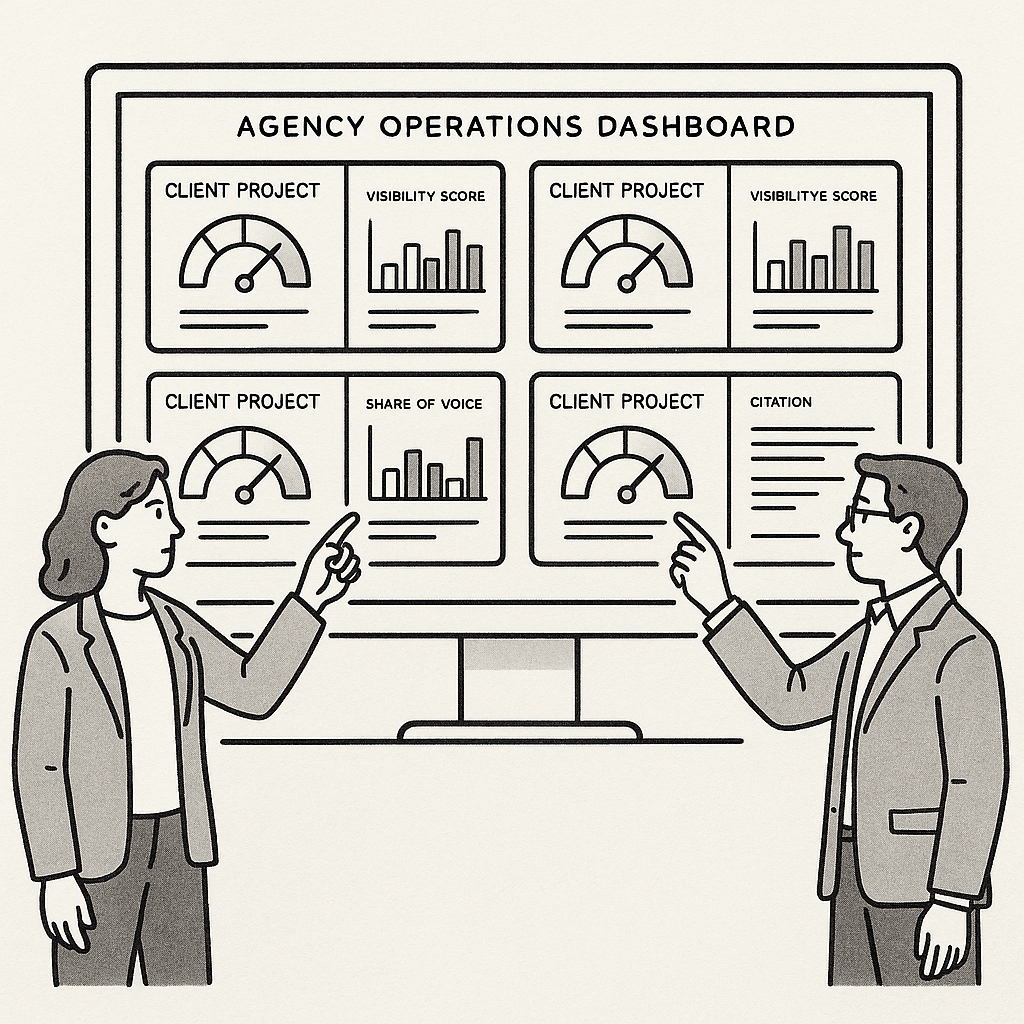
Alef's platform consolidates these data streams into a unified visibility dashboard, tracking presence across ChatGPT, Perplexity, Gemini, and Copilot alongside traditional search rankings. This unified view addresses a gap in the market: no single-engine tool provides the cross-engine comparison that the measurement system described above requires. By centralizing visibility data, the platform transforms the manual process into a repeatable, scalable system that grows with the brand's content investment.
The brands that win in AI-driven discovery will be those that treat visibility measurement as an ongoing operational discipline rather than a periodic audit. The system outlined here provides the framework; the discipline of execution determines the outcome.
Common Mistakes in AI Visibility Tracking
Tracking AI visibility is still a young discipline, and most teams repeat the same errors. The checklist below outlines what to avoid — and why precision matters more than volume.
- Tracking only one engine. ChatGPT visibility says nothing about Perplexity or Gemini, since each engine pulls from different sources and indexes differently; a brand absent from one may dominate another.
- Using inconsistent prompts. Changing the wording between checks makes results incomparable, so a standardized prompt library is non-negotiable for any longitudinal comparison.
- Counting mentions without context. A passing mention in a list of ten is not the same as a cited recommendation, and treating them equally distorts the report's usefulness for leadership.
- Ignoring competitor share of voice. Measuring only your own mentions misses whether competitors are winning the answers your buyers actually see in their daily workflows.
- Checking once and stopping. AI answers shift frequently as models update and crawl fresh content, so a single audit becomes stale within weeks; recurring checks are the only valid methodology.
- Forgetting AI-referred traffic. Visibility without traffic measurement leaves the team blind to whether mentions actually drive visits and pipeline, which is the metric executives ultimately reward.
- Treating every answer engine the same. Each engine has different source preferences and update cadences — crawl data shows ChatGPT's bot behaves differently from Googlebot — so optimization and measurement must be engine-specific.
Teams that avoid these pitfalls typically build a content strategy tailored to AI answer engines and pair it with AI-assisted SEO workflows to keep measurement and execution aligned. The result is a visibility program that reflects reality rather than a single engine's snapshot.
AI Visibility Tracking Summary Table
The full tracking system distills into a repeatable workflow. Each step below maps to a concrete measurement, a specific tool or method, and a verifiable outcome, so the entire process can be audited at a glance.
| Step | What to Measure | Tool/Method | Expected Outcome |
|---|---|---|---|
| 1. Define visibility sources | Engine coverage (ChatGPT, Perplexity, Gemini, Copilot) | Source inventory spreadsheet | 4 tracked engines with assigned owners |
| 2. Build a prompt library | Prompt consistency and coverage | 15–25 standardized prompts per brand category | 90%+ prompt reuse across tracking cycles |
| 3. Run baseline queries | Brand mention rate | Manual or automated query execution | Baseline mention rate of 20–40% for established brands |
| 4. Capture response data | Answer text, cited sources, position | Screenshot archive or API capture | 100% of responses stored with timestamps |
| 5. Log citation sources | Source URL frequency | Citation tracking sheet | 5–10 unique referring domains per brand |
| 6. Track share of voice | Brand vs. competitor mentions | Comparative query set (brand + 3 competitors) | Share of voice percentage per engine |
| 7. Analyze sentiment and context | Positive, neutral, or negative framing | Manual review rubric or LLM-assisted tagging | 80%+ inter-rater agreement on sentiment tags |
| 8. Monitor change over time | Mention rate delta | Weekly cadence of query reruns | Detect 10%+ shifts in mention rate within 2 weeks |
| 9. Benchmark against competitors | Competitor mention frequency | Same prompt library applied to competitor names | Relative visibility ranking per engine |
| 10. Correlate with web traffic | AI-referred sessions | Analytics segmentation by referrer | Identify which AI engines drive measurable sessions |
| 11. Report and act | Visibility trends and gaps | Monthly AI visibility report | Prioritized action list tied to specific engines |
Tracking AI visibility is not a one-time audit but a continuous discipline. The cadence, prompt standardization, and cross-engine comparison are what separate anecdotal observation from measurement a GTM team can act on.
Conclusion
AI answer engines have moved from experimental novelty to a primary discovery channel, with Google itself reporting that AI systems now drive measurable visitor traffic to publishers. Brands that continue relying solely on traditional rank tracking are flying blind in this environment, missing citations where prospects actually encounter their name.
The system is straightforward when broken into its components: define which engines matter, standardize the prompts used for measurement, run recurring brand and competitor checks, connect mentions to downstream traffic, and report findings upward with clear context. Each step compounds on the previous one, turning scattered observations into a defensible visibility baseline.
Key takeaways - AI visibility tracking must span multiple answer engines, not a single platform. - Standardized prompts make results comparable across measurement periods. - Citation context matters more than raw mention count. - Recurring checks outperform one-off audits for spotting trends. - Visibility data must feed content action, not just reporting.
What separates organizations that benefit from this data from those that merely collect it is the discipline to act. Alef's platform unifies this measurement across ChatGPT, Perplexity, Gemini, and Copilot, giving GTM teams a single view of where their brand appears — and where the gaps demand attention.
Frequently Asked Questions
What is AI visibility tracking?
AI visibility tracking is the practice of systematically measuring where and how a brand appears in AI-generated answers across ChatGPT, Perplexity, Gemini, and similar answer engines. Unlike traditional rank tracking, which measures positions in blue-link search results, AI visibility tracking captures whether a brand is mentioned by name, cited as a source, or recommended in synthesized responses. This distinction matters because AI answer engines increasingly mediate discovery, with Google itself reporting that more visitors are arriving from AI systems in its search results. A complete AI visibility tracking program monitors mention rate, citation rate, and share of voice across multiple engines simultaneously.
How do I check if my brand appears in ChatGPT?
Checking brand presence in ChatGPT requires manual prompt testing with standardized queries. Run a consistent set of brand-name prompts — such as "What is the best [category] software?" or "Recommend a [category] provider" — and record whether the response names the brand and whether that mention includes a source link. Repeat the same prompts across fresh chat sessions, since ChatGPT responses vary between sessions and model versions. For reliable comparison, log the date, the model version if visible, and whether the brand appeared in the opening answer or only in cited sources.
What is a good AI visibility score?
There is no universal benchmark for an AI visibility score yet, because the measurement discipline is too new for standardized baselines. Teams should instead track three core metrics as trends over time: mention rate (the percentage of relevant prompts where the brand appears), citation rate (the percentage of mentions that include a source link), and share of voice (the brand's proportion of mentions versus competitors). A brand that improves its mention rate from 20 percent to 45 percent over a quarter is demonstrating real progress, even if no industry-wide "good" number exists.
How often should I track AI visibility?
Weekly or biweekly checks are appropriate for AI visibility tracking because AI answer engines change frequently. Model updates, crawler behavior shifts, and content freshness all influence whether a brand appears in responses. ChatGPT's crawler activity, for instance, fluctuates in ways that differ meaningfully from Googlebot's consistent crawl patterns. A monthly cadence risks missing shifts caused by a model update or a competitor publishing new content. Weekly checks are recommended for brands in competitive categories, while biweekly tracking may suffice for niche markets with fewer active competitors.
What is the difference between AI visibility and SEO rankings?
SEO rankings measure a website's position in traditional blue-link results on engines like Google, while AI visibility measures presence and citation within synthesized answers. A brand can rank on page one for a keyword yet never appear in ChatGPT's response to the same query, because AI engines draw from different source sets and prioritize different signals. Conversely, a brand can be cited in an AI answer without ranking prominently in traditional search results. Both metrics matter, but they require separate tracking systems because the underlying retrieval and generation mechanisms differ.
Can I track AI visibility for my competitors?
Yes — running the same standardized prompts with competitor names substituted for the brand reveals share of voice and which companies win citations. This competitive tracking exposes gaps: if a competitor appears in 60 percent of relevant prompts while the brand appears in only 20 percent, the difference indicates content or authority weaknesses to address. Documenting competitor mentions alongside the brand's own results provides a comparative view that isolated brand tracking cannot offer. This competitive intelligence directly informs content strategy and knowledge base optimization priorities.
Call to Action
Measuring AI visibility across multiple answer engines does not require a patchwork of manual checks and single-engine tools. Alef's unified visibility platform consolidates brand mention monitoring, competitor comparisons, and AI visibility reporting for ChatGPT, Perplexity, Gemini, and Copilot into a single Analytics dashboard backed by AEO insights. That consolidation transforms scattered data into a repeatable measurement system — the same system outlined in this guide, automated and centralized. The next step is straightforward: begin tracking where the brand actually appears in AI-generated answers. Visit Alef to start measuring AI presence across every major answer engine.